

It is finished
GOOD FRIDAY
Blessed Holy Week, friends!
We’ve arrived at the final three days of Lent, also known as the Triduum or Three Days1. Today, we watch Jesus fulfill everything God gave him to do. It’s a beautiful, scandalous choreography from his arrest in the garden, betrayed and forsaken by his closest friends, rejected by his people, scorned, sentenced, and crucified by the whole world. In one of his final breaths, he proclaims the words we often attribute as his epitaph: It is finished.
Even as we begin to dream of Resurrection celebrations, we continue to join the lament of the Seven Last Words of Christ from the Cross with your honest lament. Today’s Gospel reading is long, yet a small way we can bear witness to the sacrificial love of our beloved friend and King.
Practice & Pray
Prayerfully contemplate and respond to today’s curation of art and music.
First, take a couple of deep breaths and relax any inner striving into a gentle openness to the Holy Spirit.
Begin with a simple breath prayer from today’s last words:
Inhale: It is
Exhale: finished
Repeat gently a few times until you sense you are ready to move forward.
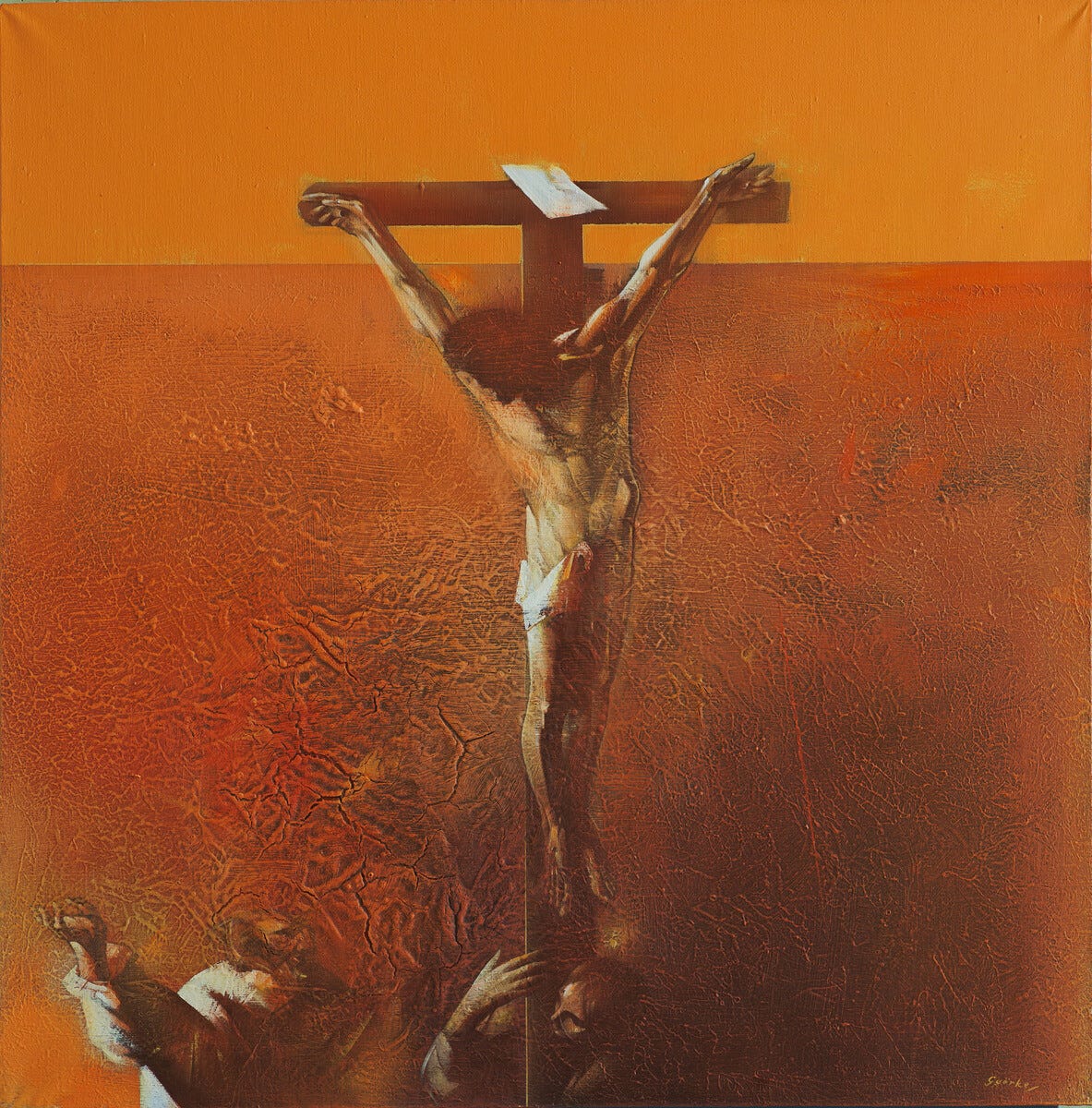
LOOK
Crucifix, Geza Gyorke - Source
LISTEN
Go to Dark Gethsemane, Lux Music - Lyrics | Spotify | YouTube
READ
Read today’s Gospel passage from the Book of Common Prayer
After Jesus had spoken these words, he went out with his disciples across the Kidron Valley to a place where there was a garden, which he and his disciples entered. Now Judas, who betrayed him, also knew the place because Jesus often met there with his disciples. So Judas brought a detachment of soldiers together with police from the chief priests and the Pharisees, and they came there with lanterns and torches and weapons. Then Jesus, knowing all that was to happen to him, came forward and asked them, “Whom are you looking for?” They answered, “Jesus of Nazareth.” Jesus replied, “I am he.” Judas, who betrayed him, was standing with them. When Jesus said to them, “I am he,” they stepped back and fell to the ground. Again he asked them, “Whom are you looking for?” And they said, “Jesus of Nazareth.” Jesus answered, “I told you that I am he. So if you are looking for me, let these people go.” This was to fulfill the word that he had spoken, “I did not lose a single one of those whom you gave me.” Then Simon Peter, who had a sword, drew it, struck the high priest’s slave, and cut off his right ear. The slave’s name was Malchus. Jesus said to Peter, “Put your sword back into its sheath. Am I not to drink the cup that the Father has given me?”
So the soldiers, their officer, and the Jewish police arrested Jesus and bound him. First they took him to Annas, who was the father-in-law of Caiaphas, the high priest that year. Caiaphas was the one who had advised the Jews that it was better to have one person die for the people.
Simon Peter and another disciple followed Jesus. Since that disciple was known to the high priest, he went with Jesus into the courtyard of the high priest, but Peter was standing outside at the gate. So the other disciple, who was known to the high priest, went out, spoke to the woman who guarded the gate, and brought Peter in. The woman said to Peter, “You are not also one of this man’s disciples, are you?” He said, “I am not.” Now the slaves and the police had made a charcoal fire because it was cold, and they were standing around it and warming themselves. Peter also was standing with them and warming himself.
Then the high priest questioned Jesus about his disciples and about his teaching. Jesus answered, “I have spoken openly to the world; I have always taught in synagogues and in the temple, where all the Jews come together. I have said nothing in secret. Why do you ask me? Ask those who heard what I said to them; they know what I said.” When he had said this, one of the police standing nearby struck Jesus on the face, saying, “Is that how you answer the high priest?” Jesus answered, “If I have spoken wrongly, testify to the wrong. But if I have spoken rightly, why do you strike me?” Then Annas sent him bound to Caiaphas the high priest.
Now Simon Peter was standing and warming himself. They asked him, “You are not also one of his disciples, are you?” He denied it and said, “I am not.” One of the slaves of the high priest, a relative of the man whose ear Peter had cut off, asked, “Did I not see you in the garden with him?” Again Peter denied it, and at that moment the cock crowed.
Then they took Jesus from Caiaphas to Pilate’s headquarters. It was early in the morning. They themselves did not enter the headquarters, so as to avoid ritual defilement and to be able to eat the Passover. So Pilate went out to them and said, “What accusation do you bring against this man?” They answered, “If this man were not a criminal, we would not have handed him over to you.” Pilate said to them, “Take him yourselves and judge him according to your law.” The Jews replied, “We are not permitted to put anyone to death.” (This was to fulfill what Jesus had said when he indicated the kind of death he was to die.)
Then Pilate entered the headquarters again, summoned Jesus, and asked him, “Are you the King of the Jews?” Jesus answered, “Do you ask this on your own, or did others tell you about me?” Pilate replied, “I am not a Jew, am I? Your own nation and the chief priests have handed you over to me. What have you done?” Jesus answered, “My kingdom does not belong to this world. If my kingdom belonged to this world, my followers would be fighting to keep me from being handed over to the Jews. But as it is, my kingdom is not from here.” Pilate asked him, “So you are a king?” Jesus answered, “You say that I am a king. For this I was born, and for this I came into the world, to testify to the truth. Everyone who belongs to the truth listens to my voice.” Pilate asked him, “What is truth?”
After he had said this, he went out to the Jews again and told them, “I find no case against him. But you have a custom that I release someone for you at the Passover. Do you want me to release for you the King of the Jews?” They shouted in reply, “Not this man but Barabbas!” Now Barabbas was a rebel.
Then Pilate took Jesus and had him flogged. And the soldiers wove a crown of thorns and put it on his head, and they dressed him in a purple robe. They kept coming up to him, saying, “Hail, King of the Jews!” and striking him on the face. Pilate went out again and said to them, “Look, I am bringing him out to you to let you know that I find no case against him.” So Jesus came out wearing the crown of thorns and the purple robe. Pilate said to them, “Behold the man!” When the chief priests and the police saw him, they shouted, “Crucify him! Crucify him!” Pilate said to them, “Take him yourselves and crucify him; I find no case against him.” The Jews answered him, “We have a law, and according to that law he ought to die because he has claimed to be the Son of God.”
Now when Pilate heard this, he was more afraid than ever. He entered his headquarters again and asked Jesus, “Where are you from?” But Jesus gave him no answer. Pilate therefore said to him, “Do you refuse to speak to me? Do you not know that I have power to release you and power to crucify you?” Jesus answered him, “You would have no power over me unless it had been given you from above; therefore the one who handed me over to you is guilty of a greater sin.” From then on Pilate tried to release him, but the Jews cried out, “If you release this man, you are no friend of Caesar. Everyone who claims to be a king sets himself against Caesar.”
When Pilate heard these words, he brought Jesus outside and sat on the judge’s bench at a place called The Stone Pavement, or in Hebrew Gabbatha. Now it was the day of Preparation for the Passover, and it was about noon. He said to the Jews, “Here is your King!” They cried out, “Away with him! Away with him! Crucify him!” Pilate asked them, “Shall I crucify your King?” The chief priests answered, “We have no king but Caesar.” Then he handed him over to them to be crucified.
So they took Jesus, and carrying the cross by himself he went out to what is called the Place of the Skull, which in Hebrew is called Golgotha. There they crucified him and with him two others, one on either side, with Jesus between them. Pilate also had an inscription written and put on the cross. It read, “Jesus of Nazareth, the King of the Jews.” Many of the Jews read this inscription because the place where Jesus was crucified was near the city, and it was written in Hebrew, in Latin, and in Greek. Then the chief priests of the Jews said to Pilate, “Do not write, ‘The King of the Jews,’ but, ‘This man said, I am King of the Jews.’ ” Pilate answered, “What I have written I have written.” When the soldiers had crucified Jesus, they took his clothes and divided them into four parts, one for each soldier. They also took his tunic; now the tunic was seamless, woven in one piece from the top. So they said to one another, “Let us not tear it but cast lots for it to see who will get it.” This was to fulfill what the scripture says,
“They divided my clothes among themselves,
and for my clothing they cast lots.”And that is what the soldiers did.
Meanwhile, standing near the cross of Jesus were his mother, and his mother’s sister, Mary the wife of Clopas, and Mary Magdalene. When Jesus saw his mother and the disciple whom he loved standing beside her, he said to his mother, “Woman, here is your son.” Then he said to the disciple, “Here is your mother.” And from that hour the disciple took her into his own home.
After this, when Jesus knew that all was now finished, he said (in order to fulfill the scripture), “I am thirsty.” A jar full of sour wine was standing there. So they put a sponge full of the wine on a branch of hyssop and held it to his mouth. When Jesus had received the wine, he said, “It is finished.” Then he bowed his head and gave up his spirit.
Since it was the day of Preparation, the Jews did not want the bodies left on the cross during the Sabbath, especially because that Sabbath was a day of great solemnity. So they asked Pilate to have the legs of the crucified men broken and the bodies removed. Then the soldiers came and broke the legs of the first and of the other who had been crucified with him. But when they came to Jesus and saw that he was already dead, they did not break his legs. Instead, one of the soldiers pierced his side with a spear, and at once blood and water came out. (He who saw this has testified so that you also may believe. His testimony is true, and he knows that he tells the truth, so that you also may continue to believe.) These things occurred so that the scripture might be fulfilled, “None of his bones shall be broken.” And again another passage of scripture says, “They will look on the one whom they have pierced.” (John 18:1-40, 19:1-37)
PRACTICE & PRAY
Spend some quiet moments reflecting on Jesus’s last words by adding your words and stories of lament. You may want to use a journal or a sketch pad to let this exercise involve your heart, mind, and body.
First, gently reflect on today’s last words of Jesus: It is finished.
When Jesus had received the vinegar, he said, “It is finished”; and he bowed his head and gave up his spirit. —John19:30
Then, ask for the Spirit to help you lament. Begin with a simple prayer:
God please guide my reflections by your Holy Spirit. Give me language to express my lament in your presence and within your beloved community.
In a journal, sketch pad, or with a trusted friend, consider one or more of the following questions to help guide your lament story (you may want to set a timer for this):
When you hear the word "finished," does it evoke comfort—as in something completed, whole—or discomfort, as in something cut short? What stories from your life correspond to that comfort or discomfort?
What prolonged suffering or unresolved grief in your life do you need Jesus' help to finish?
What relationships have finished too soon in your life? In what way does that make "it is finished" sound like lament rather than accomplishment?
What has Jesus helped you release into the finishing work of the cross?
When you’ve been able to give voice to your lament, or you feel weary, close your reflection with prayer:
How can we ever find words to express our gratitude to you, dear Lord? You did what we could not do. You defeated our enemy, death by giving yourself to it. You obeyed the father with every single breath until your last breath. Help us live and die with that same devotion and love. We sit today in the knowledge that while death has been ultimately destroyed we still feel its sting. We lament the moments when we thought, “Is this it? Is this how it ends?” We wait for every sad ending to be undone.
In the meantime…
Spirit of God, thank you for giving me language for my lament. I trust you to pray for me the words I could not. I trust you to help me share my lament with your beloved community. In the restful name of Jesus, Amen.
Close this time by sitting quietly, allowing all that has been stirred to settle like a palm branch that you lay down. Set your timer for at least 5 minutes and recline. Curl up with a blanket and a pillow, and close your eyes. If you have napping children at home, take a nap with them or cuddle with a loved one or sleepy pet.
As your mind fights you with distractions, breathe in and out slowly the words of today’s breath prayer. Trust Jesus to hold together all you need as you spend a few moments for physical rest. Thank Jesus for inviting you to keep company with him in his lament and yours.
For further reflection
It is finished: You can read lament stories from previous years in my blog archives.
Lent Daily Office: If you’d like to continue praying the Daily Office from the Book of Common Prayer through Holy Week, you can access this week’s scripture readings and morning and evening prayers on my church’s website.
Invite your friends to join A Restful Holy Week!
Enjoy my Restful Holy Week playlist
The Paschal (Easter) Triduum (“three days”) begins on the evening of Maundy Thursday (the liturgical day beginning at sundown, just like in the Jewish calendar). The Triduum includes Maundy Thursday, Good Friday, Holy Saturday, and Easter Sunday. It ends at sundown on Easter. (via Anglican Compass)